
This guide covers the mechanics of SEO and how it works – how search engines discover, evaluate, and rank content – and the practical steps to implement a strategy that produces measurable organic traffic. It covers on-page optimization, technical foundations, and link acquisition. It does not cover paid search (Google Ads), social media algorithms, or email marketing, even though those channels interact with organic performance.
Who This Is For (And Who Should Stop Reading)
This is written for marketers, founders, and content managers who are responsible for a website’s organic performance and want to understand SEO beyond surface-level advice. You should be comfortable with basic website concepts – you know what a URL is, you’ve heard of meta tags, and you’re not afraid of Google Search Console.
Stop reading if: You’re looking for a shortcut to rank in two weeks, you want someone to validate buying links in bulk, or you believe AI-generated content at scale will solve your traffic problem without editorial oversight. None of that is in here, because none of it holds up.
This guide assumes you have access to at least one keyword research tool (Ahrefs, Semrush, or Google Keyword Planner), a website you can edit, and enough patience to wait 3–6 months for meaningful results.
What Is SEO and How Does It Work?
SEO – search engine optimization – is the practice of improving a website so that search engines rank it higher for relevant queries, driving unpaid organic traffic. It works by aligning three things: how accessible your site is to crawlers, how relevant your content is to specific search queries, and how authoritative your domain appears based on who links to it.
The reason SEO takes months rather than days is structural. Google doesn’t promote pages it hasn’t had time to evaluate, and evaluation requires crawl data, user behavior signals, and link pattern analysis – none of which appear overnight. Understanding what SEO is and how it works is the difference between building a strategy with realistic expectations and burning budget on tactics that can’t deliver on their timeline.
The Core Protocol
Step 1: Understand What Search Engines Actually Do
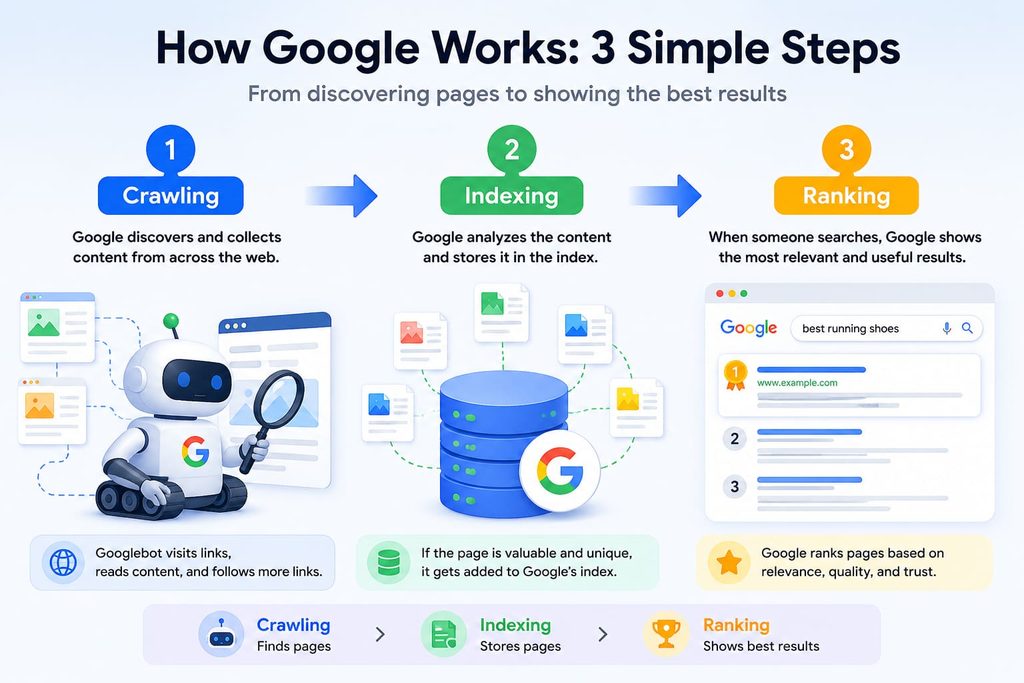
Google’s process has three distinct phases: crawling, indexing, and ranking. Googlebot crawls pages by following links. It passes discovered URLs to the indexer, which stores a processed version of the page. Ranking happens at query time – Google pulls relevant indexed pages and scores them against hundreds of signals to produce the SERP.
Your job is to make each phase frictionless. A page that can’t be crawled doesn’t exist. A page that’s indexed but poorly optimized doesn’t rank. A page that ranks but doesn’t satisfy search intent doesn’t convert.
Step 2: Define Search Intent Before Touching a Keyword
Search intent is the single most important concept in modern SEO. Google classifies queries into four types: informational (how does X work), navigational (brand name searches), commercial investigation (best X for Y), and transactional (buy X now). Match the wrong format to the intent and you won’t rank, regardless of how well-optimized the page is.
Run the query yourself. Look at the top 5 results. If they’re all listicles, write a listicle. If they’re all product pages, a blog post won’t break through. The SERP is Google’s best guess at what the searcher wants – treat it as a spec document.
One pattern I’ve seen repeatedly: teams spend weeks producing a definitive 4,000-word guide only to find the top 10 results are all concise FAQ pages under 800 words. The guide is better content by any editorial measure. It doesn’t matter. Google has already inferred from user behavior that searchers want a quick answer, not depth. Match the format first, then compete on quality within that format.
Step 3: Keyword Research With Real Criteria
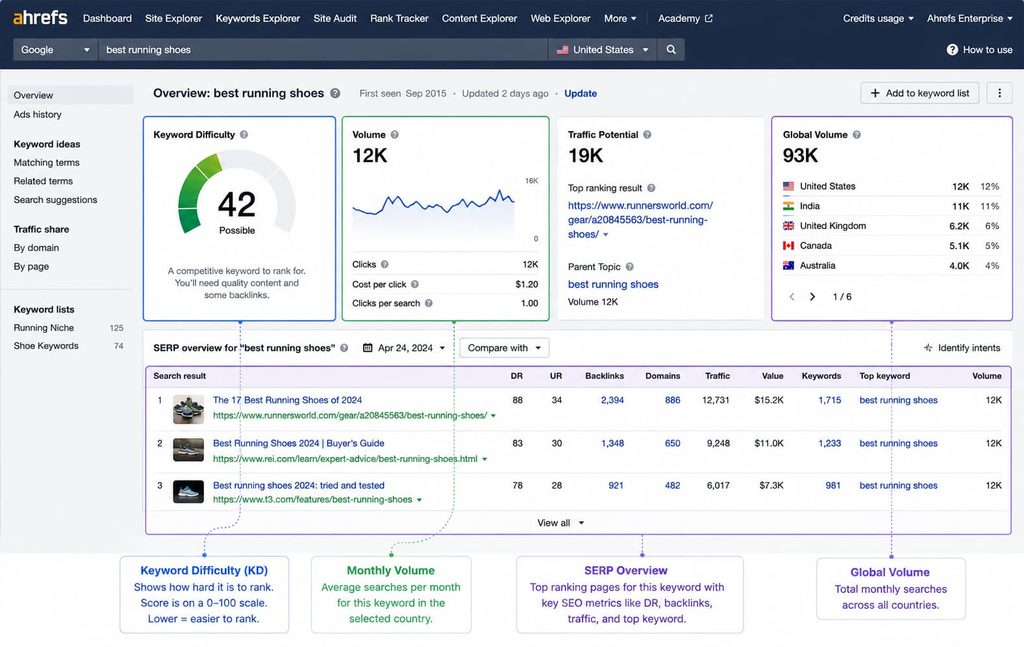
Target keywords with a Keyword Difficulty (KD) score under 40 if your domain rating (DR) is below 30 in Ahrefs terms. New sites chasing head terms like “project management software” (KD 85+) are wasting resources. Start with long-tail terms: “project management software for construction teams” has a fraction of the volume but a DR 20 site can actually rank for it.
Look for three things in a target keyword: monthly search volume above 100 (below that, even a #1 ranking barely moves traffic), a realistic KD given your current authority, and clear commercial or informational intent that matches what you’re building.
Step 4: On-Page Optimization – The Actual Mechanics
Write your title tag to include the primary keyword near the front and stay under 60 characters. Google rewrites title tags it considers misleading or truncated, and when that happens, you lose click-through rate control.
Your H1 should match or closely paraphrase the title tag. One H1 per page, no exceptions. Use H2s for major subtopics and H3s for supporting points inside those subtopics – this hierarchy is how both users and crawlers parse structure.
Put the primary keyword in the first 100 words of the body copy. Use semantically related terms throughout – if you’re writing about “email deliverability,” terms like SPF records, DKIM, bounce rate, and sender reputation should appear naturally. These aren’t stylistic suggestions; they’re how Google’s natural language processing confirms topical relevance.
Meta descriptions don’t directly affect rankings, but they affect click-through rate, which affects traffic. Write them as a 150–160 character pitch, not a summary.
Internal links matter more than most practitioners actually apply them. Every new piece of content should receive at least 3–5 internal links from existing pages with relevant anchor text. This distributes PageRank (yes, it still exists and still matters) and tells Google which pages you consider important.
Step 5: Technical SEO – The Non-Negotiables
Page speed is a confirmed ranking factor via Core Web Vitals. Target a Largest Contentful Paint (LCP) under 2.5 seconds, a Cumulative Layout Shift (CLS) under 0.1, and an Interaction to Next Paint (INP) under 200ms. Use PageSpeed Insights or the Core Web Vitals report in Google Search Console to identify failures.
Your site needs HTTPS. Google has used it as a ranking signal since 2014, and browsers flag HTTP sites as insecure. This is not optional infrastructure.
Set up a clean XML sitemap and submit it in Google Search Console. Fix crawl errors – 404s, redirect chains longer than 2 hops, canonicalization conflicts – before scaling content. Running a full crawl with Screaming Frog’s free tier (up to 500 URLs) or the paid version before doing anything else is standard practice for a reason: you often find that 20% of the site is broken before you’ve published a single new page.
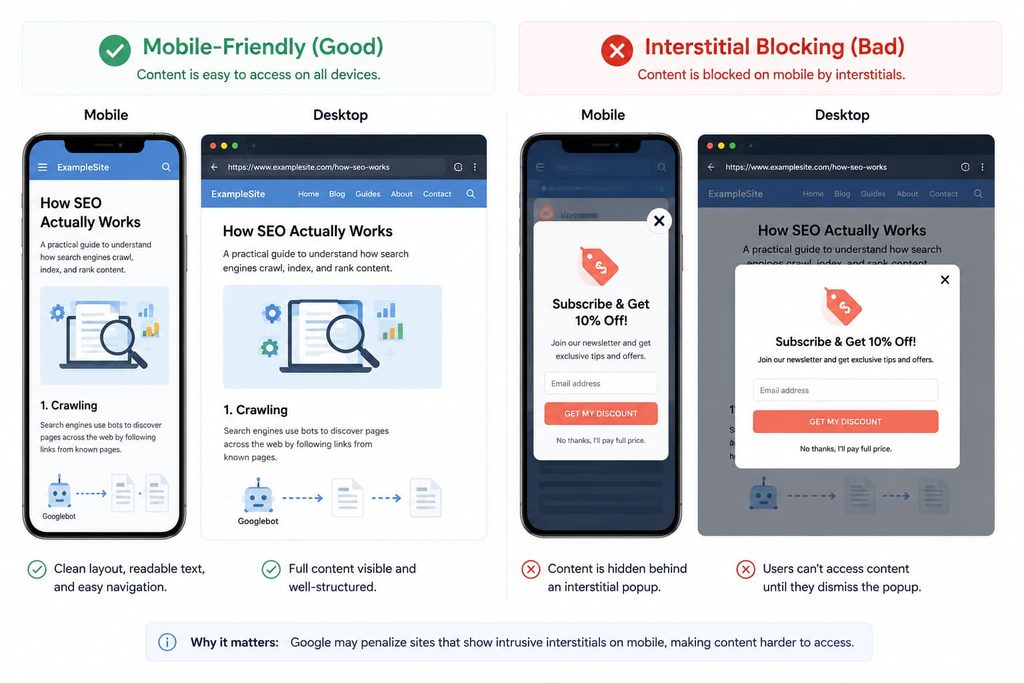
Mobile-first indexing has been the default since 2021. Google indexes the mobile version of your site. If your mobile experience is degraded – font too small, tap targets too close together, content hidden behind interstitials – you’re penalizing your own rankings.
Step 6: Link Acquisition – The Part Everyone Gets Impatient About
Backlinks remain the strongest off-page ranking signal. A page with 50 high-quality backlinks from authoritative, topically relevant domains will outrank a technically perfect page with zero backlinks on competitive queries almost every time.
Three link acquisition approaches that hold up consistently: digital PR (creating data-driven content that journalists cite), link insertions (reaching out to existing articles to add your link where it adds genuine value), and guest posting on relevant industry publications. Cold outreach converts at roughly 3–8% when the pitch is genuinely useful to the recipient. That means sending 50 emails to get 2–4 links. That’s not a flaw in the strategy – that’s the business, and anyone promising you better conversion rates at scale is cutting corners somewhere.
Aim for links from domains with DR 40+ in your niche. A single link from a DR 70 industry publication is worth more than 20 links from DR 15 sites with no real traffic.
Contraindications: When NOT to Use This Protocol
Don’t run a standard SEO campaign on a brand-new domain with a launch deadline of 60 days. SEO takes time – most new pages take 3–6 months to appear in the top 10, and that’s with active promotion. If you need traffic in 60 days, run paid search alongside building the organic foundation.
Don’t apply aggressive link building to a site that’s already received a manual action from Google (visible in Search Console under Security & Manual Actions). Fix the underlying issue first. Building links into a penalized site is pouring water into a bucket with a hole in it.
Don’t prioritize SEO for pages with no clear business purpose. Driving organic traffic to a page that doesn’t convert, build an audience, or serve a navigational need just inflates vanity metrics.
How This Is Typically Done Wrong
Targeting keywords by volume alone. Marketers see a keyword with 50,000 monthly searches and build a content plan around it without checking the KD or the SERP composition. They spend three months on a blog post only to find the top 10 results are all massive authoritative domains with thousands of backlinks. The fix is to qualify every keyword by difficulty and competitive landscape before committing resources.
Publishing without addressing search intent. A SaaS company creates a detailed technical whitepaper targeting “what is CRM software” – a query where Google consistently serves simplified beginner guides. The whitepaper is excellent content. It never cracks page 2 because it’s the wrong format for the intent. Always audit the SERP format before writing a word.
Ignoring internal linking. Teams spend significant budget on content production and zero budget on internal linking. New pages sit with no internal links pointing to them, making it harder for Google to discover and assess their importance. This is a fixable, free problem that compounds over time. A quarterly internal link audit – going through your top 20 existing pages and adding links to newer content – costs two hours and pays off consistently. It’s also one of the highest-ROI activities in SEO that almost nobody does on a schedule.
For Auditing technical SEO, you can use Claude or other AIs or Screaming Frog tools.
Edge Cases That Require Deviation
Local SEO follows a different playbook. Google Business Profile optimization, local citation consistency (NAP: Name, Address, Phone), and proximity signals matter far more than domain authority for map pack rankings. A local plumber with a DR of 12 can outrank a national plumbing directory in their city if their GBP is fully optimized and they have 80+ genuine reviews.
Programmatic SEO – where you’re generating thousands of pages from a database (think Zapier’s integrations directory or Tripadvisor’s city pages) – requires a different content quality threshold check. Google’s helpful content guidance hits hardest on thin programmatic pages. Each template needs enough unique, useful content per page to justify its existence. Programmatic SEO done right scales. Done wrong, it earns a sitewide quality demotion that can take 12+ months to recover from.
E-commerce category pages respond differently to content strategies than blog posts. Long-form content above product grids rarely helps and sometimes hurts conversion rates. For category pages, focus on technical optimization, faceted navigation handling (canonicalization of filtered URLs), and acquiring links directly to the category page rather than writing 1,500 words about “running shoes.”
When to Escalate to a Professional
Bring in a technical SEO specialist when Google Search Console shows more than 15% of your indexed pages have crawl anomalies, when a site migration (domain change, platform change, HTTP to HTTPS) is on the roadmap, or when organic traffic dropped more than 20% in a 30-day window without an obvious content change on your end.
Bring in a link acquisition specialist when you’ve been publishing quality content for 6+ months, your DR has stayed flat, and your target keywords are stuck on page 2–3. Organic content alone rarely builds authority fast enough on competitive topics without a deliberate off-page strategy running in parallel.
If your site has received a manual penalty or you suspect a Google algorithmic filter – traffic drops that correlate to confirmed algorithm updates, which you can track at Search Engine Land or via Glenn Gabe’s site – that’s not a DIY situation. The diagnostic and recovery process requires someone who has done it before and can read the pattern in the GSC data without guessing.
A mid-size e-commerce brand selling outdoor gear came to us after six months of stagnant organic traffic – around 8,200 monthly visits with no meaningful growth. Their content was solid and their backlink profile was clean. The issue was invisible to them: a JavaScript rendering problem was blocking Googlebot from indexing roughly 40% of their product pages. Within 11 weeks of the fix, indexed pages climbed from 1,800 to 3,100, and organic sessions hit 14,600 the following month. No new content. No new links. Just making the existing site crawlable.
Key References and Standards
Google Search Essentials (formerly Webmaster Guidelines) – the official documentation for what Google considers acceptable optimization. Read it once a year; it updates.
Google Search Central Blog – the primary channel for algorithm update confirmations and guidance changes. Bookmark it and check it when traffic moves unexpectedly.
Core Web Vitals thresholds – maintained at web.dev/vitals. The INP metric replaced FID in March 2024. Any SEO guide still referencing First Input Delay as a current ranking signal is working from outdated information.
E-E-A-T (Experience, Expertise, Authoritativeness, Trustworthiness) – Google’s quality evaluator framework, detailed in the Search Quality Rater Guidelines (a 170+ page public document). It’s not a direct ranking factor, but it shapes the thinking behind Google’s quality classifiers. Author bios, first-hand experience signals, and accurate citations all feed into how those systems assess content quality.
Ahrefs, Semrush, and Moz each calculate keyword difficulty using different methodologies – KD scores are not directly comparable across tools. A KD of 35 in Ahrefs is not the same as a KD of 35 in Semrush. Calibrate your thresholds to whichever tool you use consistently and don’t mix them.
Google Search Console and Google Analytics 4 are non-negotiable. Free, first-party data. If you’re making SEO decisions without GSC data showing impressions, clicks, and average position by query, you’re flying blind on an instrument that’s been available to you the entire time.
The basics of SEO – and how it works at a fundamental level – have been remarkably stable for a decade: crawlable site, clear intent match, useful content, authoritative links. What changes is the threshold for quality and the sophistication of intent matching. The teams that treat SEO as a long-term asset rather than a traffic hack are the ones with compounding organic returns two years from now, while everyone else is resetting their strategy after the next algorithm update.
