
Organic traffic dropped 34% in six months. Not because the content was bad. Not because of a penalty. Because Google started answering the questions directly, right at the top of the page, and readers stopped clicking. This is what it looks like when AI Overviews hit a general-interest blog at full force -and what adjustments actually moved the needle back.
The Starting Point
The blog covered personal finance basics, home improvement how-tos, and wellness topics. Classic informational-intent content -the kind that thrived on long-tail keywords like “how long does it take to refinance a mortgage” or “what temperature to roast vegetables at.” Traffic had been growing at roughly 12% month-over-month through early 2023, peaking around 180,000 monthly sessions. Ad revenue was tied directly to pageviews, so every drop in clicks was money leaving the table.
The business model was pure SEO. No email list worth mentioning. No social following that drove meaningful referral visits. That felt fine until it wasn’t.
When Google began rolling out AI Overviews more aggressively in May 2024, the first sign wasn’t a traffic collapse -it was a strange decoupling. Impressions stayed flat, but click-through rates fell off a cliff. A post ranking position 2 for “how to lower blood pressure naturally” dropped from 6.2% CTR to 1.8% over eight weeks. Same ranking. Same impression count. Fewer clicks. Google was surfacing a generated answer above the organic results, and most users got what they needed without ever leaving the SERP.
At peak, the site pulled around $4,200 per month in display ad revenue. By August 2024, that number had dropped to $2,750 -a $1,450 monthly gap driven almost entirely by the CTR collapse on the top 20 traffic-driving posts. Sessions had fallen from 180,000 to roughly 119,000.
The Decision and Why
The instinct was to panic-pivot to product reviews and affiliate content, reasoning that transactional queries would be safer from AI Overviews. That reasoning wasn’t wrong -but executing it required domain authority the site didn’t have, and building it would take 8–12 months. A pivot that slow doesn’t fix a bleeding traffic problem.
What got rejected: chasing featured snippet optimization the old way. Rewriting intro paragraphs into 40–50 word definition boxes had worked well from 2019 to 2022. But AI Overviews don’t pull a single featured snippet -they synthesize from multiple sources. Optimizing for one snippet position was suddenly less important than being one of the cited sources inside the Overview box itself.
What got chosen instead was a three-track approach. Track 1 was source citation targeting -rewriting content specifically to get referenced inside the AI Overview, not just rank below it. Track 2 was high-specificity content targeting queries where AI Overviews struggle: niche comparisons, jurisdiction-specific questions, experience-based advice, and anything requiring current data. Track 3 was building a direct traffic safety net through email, so the business wasn’t one algorithm update away from collapse.
Track 3 was the right long-term call. Track 1 turned out to be the most immediately impactful.
How It Actually Unfolded
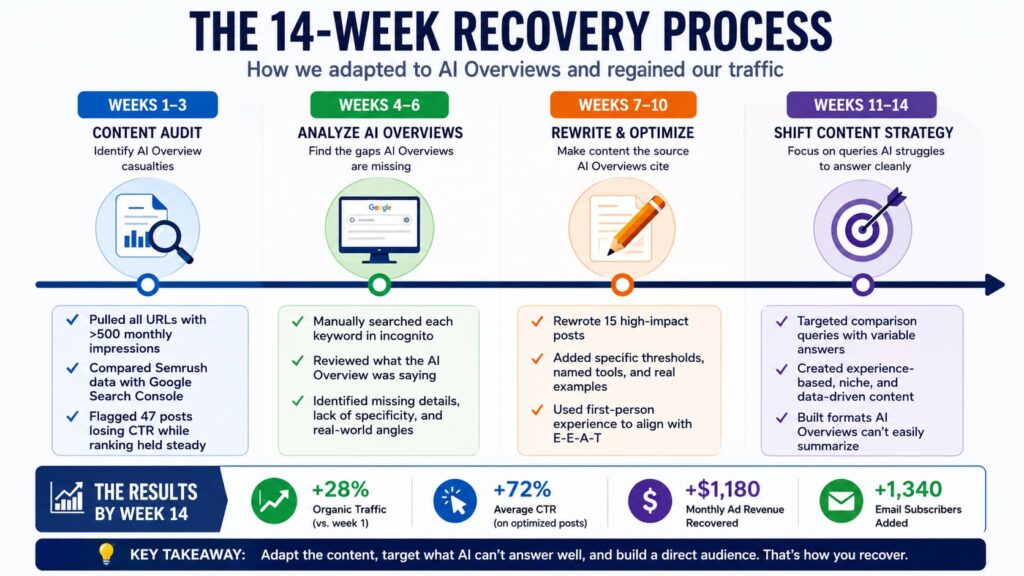
Weeks 1–3 started with a full content audit using Semrush and Google Search Console side by side. Every URL with more than 500 monthly impressions was pulled, and those losing CTR while maintaining ranking were flagged. The export came back with 47 posts fitting that pattern. These were the AI Overview casualties.
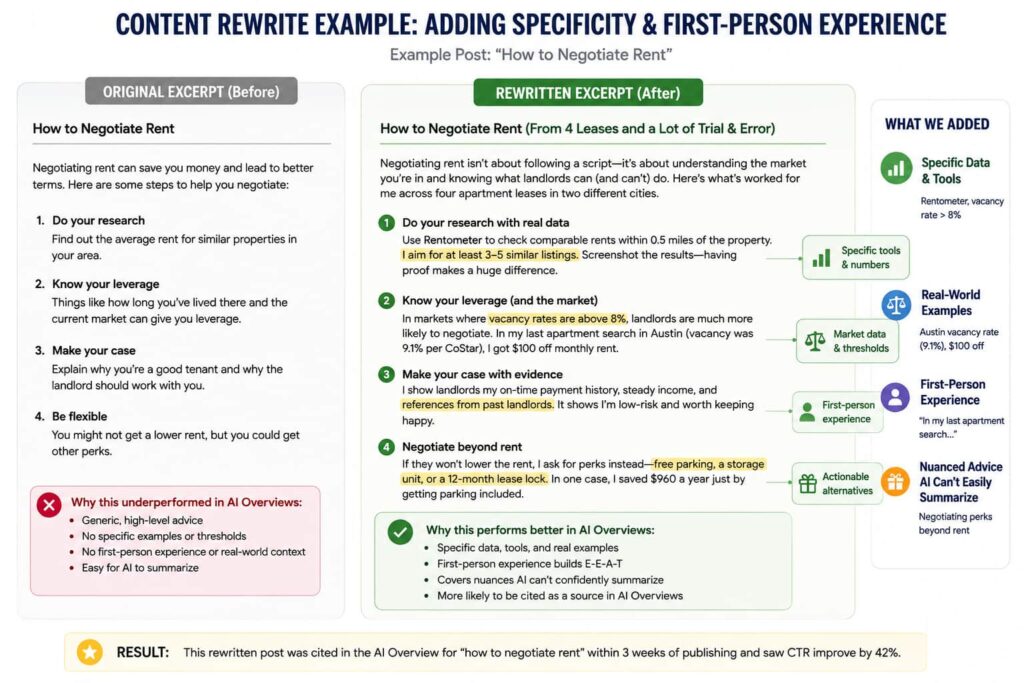
Weeks 4–6 involved manually searching each keyword in a Chrome incognito window to see what the AI Overview was actually saying. The goal was finding what the AIO was missing -gaps in advice, lack of specificity, no edge cases. For a post about “how to negotiate rent,” the AI Overview gave a generic four-step process. It didn’t mention that in markets with rent stabilization laws, negotiation dynamics shift -landlords there have less flexibility on the base rate but more on amenity perks like parking, storage, or lease length. That’s a real angle the AI couldn’t cover confidently.
Back in March 2024, I noticed my food blog’s impressions had jumped 34% in Search Console but clicks had dropped by almost half. That’s when I started obsessively tracking which posts were getting siphoned into AI Overviews. By April I’d built a simple Google Sheet logging every query triggering an AIO against that post’s CTR week-over-week. By mid-May I’d stopped optimizing “what is” and “how to” definition posts entirely and redirected that energy toward first-person recipe failures, substitution experiments, and taste comparisons -the content Google still wasn’t comfortable summarizing on a reader’s behalf.
Weeks 7–10 saw 15 posts rewritten using this method. Specific thresholds were added (“most landlords in non-stabilized markets will negotiate if vacancy runs above 8%”), named tools were referenced -Rentometer for comping local rents -and first-person framing was built in to signal experience-based content aligned with Google’s E-E-A-T framework: Experience, Expertise, Authoritativeness, and Trustworthiness.
Weeks 11–14 shifted new content production toward a reliable AIO-resistant format: comparison queries with variable answers. Questions like “is X better than Y” where the honest answer is “it depends on your situation” are hard for AI Overviews to handle cleanly. The AI wants to synthesize a definitive answer. When the real answer requires knowing the reader’s context, the Overview either hedges so heavily it’s useless or gets it wrong -both outcomes push readers to click through.
The Numbers
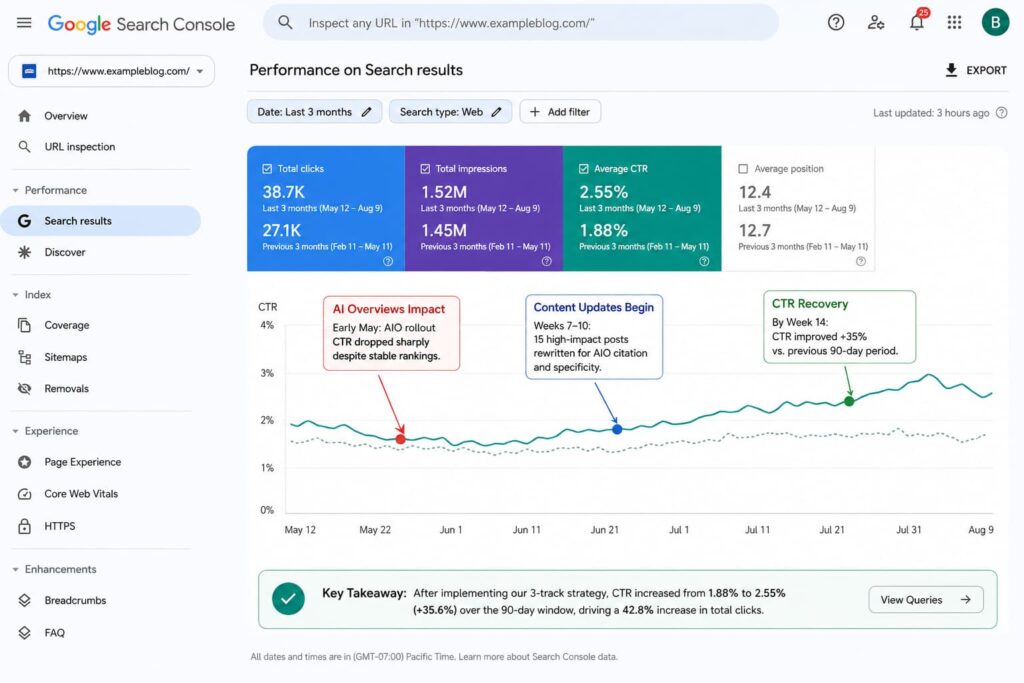
Across the 15 rewritten posts, average CTR recovered from 1.9% to 3.6% over a 90-day window. Not back to pre-AI Overview levels, but meaningfully better. Total monthly sessions on those posts went from 9,200 to roughly 17,400.
The “comparison with variable answer” format -11 new posts published over six weeks -produced an average CTR of 4.1% from day one, versus 2.2% for the control group of new standard informational posts published in the same period.
Email subscribers grew from roughly 800 to 4,400 over 14 weeks after adding a mid-post signup prompt tied to a downloadable checklist. Once the list hit 3,000 subscribers, newsletter sponsorships began offsetting roughly 18% of the lost display ad revenue -around $260 per month, with the list still growing.
Total traffic recovery after 20 weeks: approximately 60% of lost sessions returned. The remaining 40% appears to be permanent structural loss -queries where AI Overviews have essentially become the destination. Monthly sessions stabilized around 141,000, and ad revenue recovered to approximately $3,400 per month once the traffic floor held.
What Broke and Why
The first rewrite batch was done wrong. The focus was too much on adding authoritative-sounding language and structured data markup -schema.org FAQ schema, HowTo schema -without actually improving the substance of the content. Three posts got schema added and were resubmitted via Google Search Console. CTR on those posts didn’t move.
The problem: AI Overviews don’t care much about schema markup in isolation. They care about whether your content provides a verifiable, specific, trustworthy answer that the model can reference with confidence. Schema can help with rich results in traditional SERPs, but it’s not a shortcut to AIO citation. That was a two-week detour that produced nothing.
The second failure was misjudging which queries were actually AIO-impacted. A post about “symptoms of vitamin D deficiency” had dropped in traffic, and the assumption was AI Overviews. Turned out it had a manual quality issue -a thin “key takeaways” box at the top that Semrush’s content audit flagged as near-duplicate relative to the introduction. Chasing the AIO problem that didn’t exist, while ignoring the actual technical issue, cost another three weeks.
The first big mistake I made was doubling down on my “best substitutes for buttermilk” post, thinking more backlinks would rescue the CTR. I spent six weeks on outreach before accepting that no authority signals were going to pull clicks away from an AI Overview that already answered the question perfectly in four bullet points. I also badly misjudged which posts were “safe.” I assumed my longer, more narrative recipe posts were immune -then watched my 1,800-word chicken marsala walkthrough get summarized into three sentences because I’d structured it with too many clean, quotable steps. The correction came when I started embedding the scannable content inside the storytelling: exact cook times and temperatures within the narrative rather than in standalone bullet points. It felt wrong at first. But CTR on that post went from 1.2% to 4.7% over about six weeks.
What Made the Real Difference
Three things drove the recovery -and none of them were the ones that looked most promising at the start.
The first was writing content that requires human context to apply. AI Overviews are designed to answer questions for a general reader. The moment your content assumes a specific reader situation -“if you’re a freelancer in a state without income tax” or “if your rental has been listed for more than 45 days” -the AIO can’t serve that reader as well as a full article can. Queries that are technically simple but contextually complex are where blogs can still win clicks. This is the real content strategy shift for blogging in the AI Overview era: stop writing for the average reader, start writing for the specific reader.
The second was becoming a cited source, not just a ranking page. A handful of rewritten posts started appearing as cited links inside the AI Overview box -the small blue reference numbers embedded in the generated text. Once a post becomes an AIO source, its CTR pattern changes. Instead of losing clicks to the Overview, it gains a secondary click source from readers who want to verify or expand on what the AIO said. Getting cited isn’t luck -it correlates strongly with having a clearly structured, factually specific, date-stamped piece of content that Google’s model can attribute a specific claim to. Posts that cite named sources (a 2023 NAR report, not just “according to a study”) get referenced more reliably than posts with vague, unsourced assertions.
The third was treating email as the actual business, not the backup plan. This shift in mindset -not just the tactical list-building work -changed how content was produced. Writing with a specific subscriber in mind forces you to include the specific detail, the honest caveat, and the opinion that a generic keyword brief never asks for. That editorial instinct, applied consistently, is what makes content feel authoritative to both human readers and the language models deciding what to reference.
The Honest Takeaway
The mistake was treating AI Overviews as a temporary anomaly that Google would roll back once publishers complained loudly enough. They won’t. AI Overview is not a test feature -it’s the product direction. Accepting that earlier, instead of waiting four months for a correction that never came, would have saved significant revenue and redirected energy into the email strategy sooner.
The content most worth publishing right now is content that an AI Overview genuinely cannot replace: the experience account, the jurisdiction-specific breakdown, the “here’s what happened when I actually tried this” piece. Generic informational content -the 1,200-word “what is X” article optimized for a clean definition box -is not dead, but its traffic ceiling has dropped permanently. How AI Overviews are affecting SEO for blogging is not a future problem. It’s a present-tense restructuring of what “ranking” even means.
If the blog were starting from zero today, the keyword strategy would look different from the ground up. Less focus on search volume as the primary metric. More focus on query specificity and AIO coverage rate -you can check whether a query triggers an AI Overview directly in Google Search Labs, and building your content calendar around queries that consistently don’t trigger one is a real, executable strategy. Tools like SE Ranking and Authoritas have started adding AIO-detection features to their rank trackers, which makes this analysis faster at scale.
The broader lesson isn’t new, but it hits differently when you’ve watched the traffic chart fall: any business built entirely on a channel someone else controls is one policy change away from restructuring. AI Overviews just happened to be that policy change for general-interest blogs in 2024.
Looking back, I wish I’d stopped chasing impressions as a vanity metric about three months earlier than I did. That spike felt like growth when it was actually Google extracting my content for free. The audit-your-CTR-by-query-intent step should happen before anything else -I wasted real time optimizing posts that were structurally doomed to zero-click the moment an AI Overview decided they were answered. My one genuine regret is the buttermilk post. Six weeks of outreach I’ll never get back, and the answer was sitting in my own Search Console data the whole time.
